November 3 in Japan is a holiday. Yay! More family time. Here are more details about the holiday (from Wikipedia):
Culture Day (文化の日 Bunka-no-hi) is a national holiday held annually in Japan on November 3 for the purpose of promoting culture, the arts, and academic endeavour. Festivities typically include art exhibitions, parades, and award ceremonies for distinguished artists and scholars.
Culture Day was first held in 1948, to commemorate the announcement of the post-war Japanese constitution on November 3, 1946.
November 3 was first celebrated as a national holiday in 1868, when it was called Tenchō-setsu (天長節), a holiday held in honor of the birthday of the reigning emperor—at that time, the Meiji Emperor. (See also The Emperor's Birthday.) With the death of the Meiji Emperor in 1912, November 3 ceased to be a holiday until 1927, when his birthday was given its own specific holiday, known as Meiji-setsu (明治節). As Meiji-setsu was discontinued with the announcement of Culture Day in 1948, some see Culture Day as a continuation of this tradition as well—a mere renaming of Meiji-setsu—although they are ostensibly unrelated.
As Culture Day exists to promote the arts and various fields of academic endeavor, local and prefectural governments typically choose this day to hold art exhibits, culture festivals, and parades. For example, Hakone in Kanagawa Prefecture holds the annual Federal Lord's Parade (箱根大名行列 Hakone Daimyo Gyoretsu) to exhibit Edo Period clothing and costumes. It is common for universities to present new research and projects on Culture Day.
Since 1937, the award ceremony for the prestigious Order of Culture has been held on this day. Given by the Emperor himself to those who have significantly advanced science, the arts or culture, it is one of the highest honors bestowed by the Imperial Family. The prize is not restricted to Japanese citizens, and for instance was awarded to the Apollo 11
astronauts upon their successful return from the moon.
Culture Day is statistically one of the clearest days of the year. Between 1965 and 1996, there have only been three years with rain occurring in Tokyo on Culture Day.
We still don't know what we're planning to do tomorrow but for sure we'll all be together on this holiday. :)
.....
Ruther is feeling under the weather. Which is another reason why we cannot make final plans about tomorrow. I really don't want him to get sicker than he already is. Today he sported a mild fever after we came home from church. I think the cold air and the exercise he did yesterday just wore his body down. He already took some medicine today and I urged him to drink lots of juice. Hopefully he'll be all better in a few days.
.....
Tomorrow is Mama's birthday. That's Ruther's mom. We're planning to call her to greet her. We already sent her a birthday card and Nikki made her a small poster for her birthday so we hope she got it days ago just so she'll know we remembered her. I'm sure she'll be glad to hear from us because with Russell (Ruther's younger brother) in Dubai and Ron (the youngest) in Laguna for work, it can get quite lonely at home with just Papa as her companion. So hopefully we'll be able to cheer her up and make it a nice day for her.
.....
It's getting to be quite cold these days. We've had 12-degree nights and now the boys are usually in pajamas (at their request). I have to dress them up in the bathroom after their bath because it's just too cold to dress outside the warmth of the bathroom. After their bath, the boys' legs are like chalkboards where you could draw and write on them using your fignernail because of the dryness but it's nothing a good dollop of lotion can't remedy. I'm having some rashes/allergy from the cold as well but thank goodness my sister sent me some ointment so that's well under control. It's been wonderful going out because we don't sweat in the sun anymore and the boys are comfy running around but it's just a bit of a hassle bringing jackets in the bag just in case the day gets a little bit too cold. But then again, we are adjusting quite well and despite the little setbacks, we are still really happy to be here.
Showing posts with label facts. Show all posts
Showing posts with label facts. Show all posts
Sunday, November 02, 2008


Wednesday, April 09, 2008
ARAW NG KAGITINGAN (DAY OF VALOR)
Every year on April 9, the captured soldiers are honored on Araw ng Kagitingan ("Day of Valor"), also known as the "Bataan Day", which is a national holiday in the Philippines.

On April 9, 1942, 12,000 American soldiers surrendered to the Japanese at the tip of the Bataan Peninsula, which juts into Manila Bay in the Philippines. For nearly five months, the troops had fought ferociously against overwhelming odds until they ran out of food, medical supplies and ammunition. As prisoners of war (POWs), they and thousands of Filipinos were taken to a camp run by the Japanese army. This grueling series of marches are now known as the Bataan Death March. The 60th anniversary of this tragic event will be commemorated during PBS' 2002 National Memorial Day Concert. Following are some compelling - facts about the March:
During World War II, there were approximately 78,000 Allied soldiers stationed in Bataan including 12,000 Americans and 66,000 Filipinos. The poorly trained Filipinos, most of whom had never fired a weapon, were thrown into frontline combat against highly trained Japanese troops. Americans from non-combatant outfits, such as air corpsmen, and in some instances even civilians, were also formed into provisional infantry units.
Following the surrender, the Japanese army assembled the captive Fil-American soldiers in the various sectors in Bataan, but mainly at Mariveles, the southernmost tip of the Peninsula. Although American trucks were available to transport the prisoners, the Japanese decided to march the soldiers to their destination.
The Death March was really a series of marches, which lasted from five to nine days. The distance a captive had to march w as determined by the point at which he started on the trail. The full route was 55 miles long from Mariveles, Bataan, to San Fernando, Pampanga. At San Fernando, the prisoners were placed into cargo trains and transported to Capas, Tarlac, a distance of around 24 miles. They were then marched another six miles to their final destination, Camp O'Donnell.
 as determined by the point at which he started on the trail. The full route was 55 miles long from Mariveles, Bataan, to San Fernando, Pampanga. At San Fernando, the prisoners were placed into cargo trains and transported to Capas, Tarlac, a distance of around 24 miles. They were then marched another six miles to their final destination, Camp O'Donnell.
It is estimated that about 24,000 men died during the March as the tired, sick and starving troops were repeatedly beaten and denied food and water. Many of the soldiers lost their lives to dehydration and heat exhaustion. Those who tried to stop for water or to accept food from the local people were also killed.
Approximately 1,600 Americans died in the first 40 days in Camp O'Donnell. Almost 20,000 Filipinos also lost their lives in their first four months of captivity in the same camp. O'Donnell did not have the sanitation sub-structure or water supply necessary to hold so many men and there was little medicine available to treat the dysentery and beriberi that was common among the POWs. An inadequate diet also contributed to the high death rate.
On June 6, 1942, the Japanese transferred all Americans to Cabanatuan, north of Camp O'Donnell, leaving behind 500 as caretakers and for funeral details. They in turn were sent to Cabanatuan on July 5, 1942. The Filipino prisoners were paroled, beginning in July 1942.
Cabanatuan, for most prisoners, ended up being a temporary POW camp. The Japanese had a policy - in direct violation of the Geneva Convention - that prisoners were to be used as a source of labor. Most were sent to various other camps in the Philippines, China, Japan and Korea, where they were used as slave la bor. Some worked in mines, others in farms and factories, while yet more unloaded ships in port areas, for the remainder of the war.
 bor. Some worked in mines, others in farms and factories, while yet more unloaded ships in port areas, for the remainder of the war.
 Most Americans did not find out about the atrocities that took place in Bataan until January 28, 1944, when the U.S. government released a joint report from the Army and Navy. This was compiled from the sworn statements of officers who survived the March and POW camps.
Bataan Day is a national holiday in the Philippines when large groups of its citizens solemnly re-walk parts of the death route and pay homage to the victims of the March. The battleground of Bataan is now a national shrine. In the U.S., the Bataan Memorial Death March takes place each year at White Sands Missile Range, New Mexico. More than 3,000 marchers from across the U.S. and from overseas tackle a 26.2-mile route through high desert terrain in honor of those who served.
Thursday, May 03, 2007
GOLDEN WEEK IN JAPAN
The Golden Week is a collection of four national holidays within seven days. In combination with well placed weekends, the Golden Week becomes one of Japan's three busiest holiday seasons, besides New Year and the Obon week.
Trains, airports and sightseeing spots get very crowded during Golden Week, and accommodation in tourist areas can get booked out well in advance.
The national holidays making up the Golden Week are:
1. April 29
Showa Day (Showa no hi): April 29 is the birthday of former Emperor Showa, who died in the year 1989. Until 2006, Greenery Day (see May 4) used to be celebrated on this day.
2. May 3
Constitution Day (Kenpo kinenbi): On this day in 1947, the new post war constitution was put into effect.
3. May 4
Greenery Day (Midori no hi): Until 2006, Greenery Day used to be celebrated on April 29, the birthday of former Emperor Showa. The day is dedicated to the environment and nature, because the emperor loved plants and nature. Before being declared Greenery Day, May 4 used to be a national holiday due to a law, which declares a day, that falls between two national holidays, a national holiday.
4. May 5
Children's Day (Kodomo no hi): The Boy's Festival (Tango no Sekku) is celebrated on this day. Families pray for the health and future success of their sons by hanging up carp streamers and displaying samurai dolls, both symbolizing strength, power and success in life. The Girl's Festival, by the way, is celebrated on March 3.
source: http://www.japan-guide.com/e/e2282.html
Many Japanese take paid time off on the intervening work days, but some companies also close down completely and give their employees time off. Golden week is the longest vacation period of the year for many Japanese jobs. Two other holidays may also be observed for most or all of a week: Oshōgatsu in January and Obon in August. Golden Week is an extremely popular time to travel. Flights, trains, and hotels are often fully booked despite significantly higher rates at this time. Popular foreign destinations in Asia, Guam, Saipan, Hawaii, and major cities in the U.S. west coast such as Los Angeles, Seattle, and San Francisco, as well as in Europe, are affected during these seasons by large numbers of Japanese tourists. http://en.wikipedia.org/wiki/Golden_Week_(Japan)
Trains, airports and sightseeing spots get very crowded during Golden Week, and accommodation in tourist areas can get booked out well in advance.
The national holidays making up the Golden Week are:
1. April 29
Showa Day (Showa no hi): April 29 is the birthday of former Emperor Showa, who died in the year 1989. Until 2006, Greenery Day (see May 4) used to be celebrated on this day.
2. May 3
Constitution Day (Kenpo kinenbi): On this day in 1947, the new post war constitution was put into effect.
3. May 4
Greenery Day (Midori no hi): Until 2006, Greenery Day used to be celebrated on April 29, the birthday of former Emperor Showa. The day is dedicated to the environment and nature, because the emperor loved plants and nature. Before being declared Greenery Day, May 4 used to be a national holiday due to a law, which declares a day, that falls between two national holidays, a national holiday.
4. May 5
Children's Day (Kodomo no hi): The Boy's Festival (Tango no Sekku) is celebrated on this day. Families pray for the health and future success of their sons by hanging up carp streamers and displaying samurai dolls, both symbolizing strength, power and success in life. The Girl's Festival, by the way, is celebrated on March 3.
source: http://www.japan-guide.com/e/e2282.html
Many Japanese take paid time off on the intervening work days, but some companies also close down completely and give their employees time off. Golden week is the longest vacation period of the year for many Japanese jobs. Two other holidays may also be observed for most or all of a week: Oshōgatsu in January and Obon in August. Golden Week is an extremely popular time to travel. Flights, trains, and hotels are often fully booked despite significantly higher rates at this time. Popular foreign destinations in Asia, Guam, Saipan, Hawaii, and major cities in the U.S. west coast such as Los Angeles, Seattle, and San Francisco, as well as in Europe, are affected during these seasons by large numbers of Japanese tourists. http://en.wikipedia.org/wiki/Golden_Week_(Japan)
Wednesday, May 02, 2007
PHILIPPINE FESTIVALS (MAY) PART 1
http://www.tourism.gov.ph/events/events_calendar.asp
DAYAW DALAN FESTIVAL May 2-3 San Jacinto, Ticao
Dayaw is an old Tigaonon term which means “to show off, parade or display”. In its strictest meaning, dayaw is to present with pride what is distinctly and essentially inherent in a person. Dalan on the other hand, means in olden times, a mountain trail which now includes path, street and highway. Dayaw Dalan Festival symbolizes the best of what the municipality of San Jacinto have as a town and as a people. The festival is held in honor of its patron saint, Santo Cristo de Burgos.
PAHAW-AS FESTIVAL May 2 Dumangas, Iloilo
Pahaw-as is a local term that means a harvest of the agricultural products from the fishponds or other water forms.
JOURNEY TO MT. HAMIGUITAN May 2- May 5 San Isidro, Davao Oriental
A trek to Mt. Hamiguitan which is the site of the 600 hectare Bonsai field: Pygmy Forest
KATAGMAN (OGTONGANON) FESTIVAL May 3 Oton, Iloilo
An annual event showcasing the rich history and culture of the municipality that dates back to the 13th century
FEAST OF THE HOLY CROSS May 3 Sta. Cruz, Marinduque
Fiesta of Sta. Cruz in honor of the Holy Cross religious, cultural, and civic activtites are lined up.
RIT-RITEMONG CAYONG FESTIVAL May 3-5 Sarrat, Ilocos Norte
This is what the Sarratenos call their fiesta which stands for liberty, courage, leadership, unity & brotherhood even in the most certain pain of death
BAWANG (GARLIC) FESTIVAL May 3 Sinait, Ilocos Sur
Competitions and exhibits include biggest garlic, longest and most creative twined garlic bulbs.
CARABAO-CARROZA FESTIVAL May 3 Pavia, Iloilo
Features a parade of 18 gaily decorated bamboo sleds and a race among carroza-pulling carabaos on a 400 meter course.
ISABELA DAY: BAMBANTI FESTIVAL May 4- May 11 Isabela
Anniversary of the establishment of the civil government of Isabela in honor of Queen Isabela II. Activities like agro-industrial trade and tourism fairs, parades, sports events, beauty pageant and others are conducted to entertain visitors.
LINGGA-ANAY May 4 Panay, Capiz
A cultural and fiesta celebration.
DAYAW DALAN FESTIVAL May 2-3 San Jacinto, Ticao
Dayaw is an old Tigaonon term which means “to show off, parade or display”. In its strictest meaning, dayaw is to present with pride what is distinctly and essentially inherent in a person. Dalan on the other hand, means in olden times, a mountain trail which now includes path, street and highway. Dayaw Dalan Festival symbolizes the best of what the municipality of San Jacinto have as a town and as a people. The festival is held in honor of its patron saint, Santo Cristo de Burgos.
PAHAW-AS FESTIVAL May 2 Dumangas, Iloilo
Pahaw-as is a local term that means a harvest of the agricultural products from the fishponds or other water forms.
JOURNEY TO MT. HAMIGUITAN May 2- May 5 San Isidro, Davao Oriental
A trek to Mt. Hamiguitan which is the site of the 600 hectare Bonsai field: Pygmy Forest
KATAGMAN (OGTONGANON) FESTIVAL May 3 Oton, Iloilo
An annual event showcasing the rich history and culture of the municipality that dates back to the 13th century
FEAST OF THE HOLY CROSS May 3 Sta. Cruz, Marinduque
Fiesta of Sta. Cruz in honor of the Holy Cross religious, cultural, and civic activtites are lined up.
RIT-RITEMONG CAYONG FESTIVAL May 3-5 Sarrat, Ilocos Norte
This is what the Sarratenos call their fiesta which stands for liberty, courage, leadership, unity & brotherhood even in the most certain pain of death
BAWANG (GARLIC) FESTIVAL May 3 Sinait, Ilocos Sur
Competitions and exhibits include biggest garlic, longest and most creative twined garlic bulbs.
CARABAO-CARROZA FESTIVAL May 3 Pavia, Iloilo
Features a parade of 18 gaily decorated bamboo sleds and a race among carroza-pulling carabaos on a 400 meter course.
ISABELA DAY: BAMBANTI FESTIVAL May 4- May 11 Isabela
Anniversary of the establishment of the civil government of Isabela in honor of Queen Isabela II. Activities like agro-industrial trade and tourism fairs, parades, sports events, beauty pageant and others are conducted to entertain visitors.
LINGGA-ANAY May 4 Panay, Capiz
A cultural and fiesta celebration.
Thursday, April 26, 2007
APRIL FESTIVALS
KUTSITSA FESTIVAL
April 26 Molave, Zamboanga del Sur
This is a thanksgiving event for a bountiful harvest, with festivities like street dancing competition and agri-trade fair.
BINIRAYAN FESTIVAL
April 27- April 29 San Jose, Antique
Celebrated annually to commemorate the landing of the ten Bornean datus and made their first settlement in the country.
SAKNUNGAN FESTIVAL
April 27- April 30 San Jose, Mindoro Occidental
Festival incorporating the exhibition of the cultural heritage of Mindoro’s ethnic communities.
YAG-YAG FESTIVAL
April 28 29 Cangmating Sibulan, Oriental Negros
Yagyag is the vernacular for spawning. The process refers in particular to the crabs and other marine creatures which gather during the months of October to December in Sapa.
MANGO-BAMBOO FESTIVAL AND TRADE FAIR
April 28 San Carlos, Pangasinan
A festival promoting San Carlos City as major trading center of bamboo based products/furniture and best producer of "carabao" mangoes and other mango variety in the country.
TINAPAHAN FESTIVAL
April 29- May 1 Lemery, Batangas
A 3-day festivities that will showcase a trade fair of agro-industrial products, lectures on livestock raising and food processing as well as food demo competition.
BAGGAK FESTIVAL
April 29 Bauang, La Union
Inland and coastal sports, beauty contest, musical extravaganzas and activities for balikbayans.
IMBAYAH
April 29- May 1 Banaue, Ifugao
Ethnic Sports Festival and thanksgiving rites featuring Ifugao's traditional practices showcased in their songs, dances, arts & crafts.
BANGUS (MILKFISH) FESTIVAL
April 30 Dagupan City, Pangasinan
Part of Dagupan’s Pistay Dayat celebration with the highlight of longest bangus (milkfish) grill covering more than 1,000 meters of the whole stretch of the main road.
source: http://www.tourism.gov.ph/events/events_calendar.asp
April 26 Molave, Zamboanga del Sur
This is a thanksgiving event for a bountiful harvest, with festivities like street dancing competition and agri-trade fair.
BINIRAYAN FESTIVAL
April 27- April 29 San Jose, Antique
Celebrated annually to commemorate the landing of the ten Bornean datus and made their first settlement in the country.
SAKNUNGAN FESTIVAL
April 27- April 30 San Jose, Mindoro Occidental
Festival incorporating the exhibition of the cultural heritage of Mindoro’s ethnic communities.
YAG-YAG FESTIVAL
April 28 29 Cangmating Sibulan, Oriental Negros
Yagyag is the vernacular for spawning. The process refers in particular to the crabs and other marine creatures which gather during the months of October to December in Sapa.
MANGO-BAMBOO FESTIVAL AND TRADE FAIR
April 28 San Carlos, Pangasinan
A festival promoting San Carlos City as major trading center of bamboo based products/furniture and best producer of "carabao" mangoes and other mango variety in the country.
TINAPAHAN FESTIVAL
April 29- May 1 Lemery, Batangas
A 3-day festivities that will showcase a trade fair of agro-industrial products, lectures on livestock raising and food processing as well as food demo competition.
BAGGAK FESTIVAL
April 29 Bauang, La Union
Inland and coastal sports, beauty contest, musical extravaganzas and activities for balikbayans.
IMBAYAH
April 29- May 1 Banaue, Ifugao
Ethnic Sports Festival and thanksgiving rites featuring Ifugao's traditional practices showcased in their songs, dances, arts & crafts.
BANGUS (MILKFISH) FESTIVAL
April 30 Dagupan City, Pangasinan
Part of Dagupan’s Pistay Dayat celebration with the highlight of longest bangus (milkfish) grill covering more than 1,000 meters of the whole stretch of the main road.
source: http://www.tourism.gov.ph/events/events_calendar.asp
Thursday, April 12, 2007
FILIPINO FAMILY TRAITS
Filipinos highly value the presence of their families more than anything. Regardless of the liberal influence they have gotten from the west, the family remained the basic unit of their society. This trait clearly shows among Filipinos abroad who suffer homesickness and tough work just to support their families back home in the Philippines. 

In a traditional Filipino family, the father is considered the head and the provider of the family while the mother takes responsibility of the domestic needs and in charge of the emotional growth and values formation of the children. They both perform different tasks and being remarked separately by the children. Children see their mothers soft and calm, while they regard their fathers as strong and the most eminent figure in the family.
Because of this remarkable closeness, parents sometimes have difficulties letting go of their children and thus results to having them stay for as long as they want. For this somehow explains why grandparents are commonly seen living with their children in the Philippines. Unlike the way people grow old in the west where they are provided with outside homes and care giving, Filipino elderly enjoy their remaining lives inside their houses with their children and grandchildren looking after them.
Another trait Filipinos made themselves exceptional from others is their strong respect for elders. Children are taught from birth how to say “po” and “opo” to teach them as early as possible how to properly respect their elders. These words are used to show respect to people of older level. Even adults will be criticized for not using these words when speaking with their parents or people older than them. Inside the family, the parents are expected to receive the highest respect from the children along with the elder siblings; as they are given more responsibilities to look after younger siblings when parents are not around.
Children fighting back or addressing parents or elder siblings with arrogant tone are not at all tolerated. They are also not allowed to leave the house without their parents’ permission. Upon arriving home, conservative families expect children to practice the kissing of hands or placing their parents or elder family members’ hand to their foreheads with the words “mano po” as a sort of greeting.
Even after finishing school, Filipino children are not obliged to get out of their homes unless they want to. In fact, most of them keep their close relationship to their parents by staying at least before they get married. Leaving them happens only when they really have to, but usually, at least one child, depending on his willingness and financial capabilities, stay even after marriage to support and look after their aging parents.
More over, Filipinos keep close connection with other relatives. They recognize them from 2nd degree to the last they can identify. As Filipinos say, “not being able to know a relative is like turning their backs from where they come from
Wednesday, April 11, 2007
TRICYCLES IN THE PHILIPPINES
Tricycles
What: motorcycles with a sidecar (passenger-cabin) on a third wheel attached
Where: everywhere, especially on smaller roads for short distances, often on roads where jeepneys or busses are not supposed to operate
The engines of the tricycles range from 50cc up to about 125cc


What: motorcycles with a sidecar (passenger-cabin) on a third wheel attached
Where: everywhere, especially on smaller roads for short distances, often on roads where jeepneys or busses are not supposed to operate
The engines of the tricycles range from 50cc up to about 125cc
Short distance and feeder trips could not be more exciting than via quick modest transports that ply even the toughest and roughest roads in the Philippines. The tricycle is a motorcycle with a sidecar, and the pedicab is a bicycle with a sidecar. These vehicles, familiar sights traversing residential routes and arterial roads, have offered much relief to commuters – especially in areas in the provinces where there are insufficient bus and jeepney services. Tricycles and pedicabs go where the brave yet heavy transports dare not go, getting people around despite heavy floods, road construction, and extreme traffic conditions. http://www.tourism.gov.ph/wow/wild_over_wheels.asp


Tuesday, April 10, 2007
ARAW NG KAGITINGAN (DAY OF VALOR)
Every year on April 9, the captured soldiers are honored on Araw ng Kagitingan ("Day of Valor"), also known as the "Bataan Day", which is a national holiday in the Philippines. 
On April 9, 1942, 12,000 American soldiers surrendered to the Japanese at the tip of the Bataan Peninsula, which juts into Manila Bay in the Philippines. For nearly five months, the troops had fought ferociously against overwhelming odds until they ran out of food, medical supplies and ammunition. As prisoners of war (POWs), they and thousands of Filipinos were taken to a camp run by the Japanese army. This grueling series of marches are now known as the Bataan Death March. The 60th anniversary of this tragic event will be commemorated during PBS' 2002 National Memorial Day Concert. Following are some compelling - facts about the March:
Following the surrender, the Japanese army assembled the captive Fil-American soldiers in the various sectors in Bataan, but mainly at Mariveles, the southernmost tip of the Peninsula. Although American trucks were available to transport the prisoners, the Japanese decided to march the soldiers to their destination.
 The Death March was really a series of marches, which lasted from five to nine days. The distance a captive had to march was determined by the point at which he started on the trail. The full route was 55 miles long from Mariveles, Bataan, to San Fernando, Pampanga. At San Fernando, the prisoners were placed into cargo trains and transported to Capas, Tarlac, a distance of around 24 miles. They were then marched another six miles to their final destination, Camp O'Donnell.
It is estimated that about 24,000 men died during the March as the tired, sick and starving troops were repeatedly beaten and denied food and water. Many of the soldiers lost their lives to dehydration and heat exhaustion. Those who tried to stop for water or to accept food from the local people were also killed.
Bataan Day is a national holiday in the Philippines when large groups of its citizens solemnly re-walk parts of the death route and pay homage to the victims of the March. The battleground of Bataan is now a national shrine. In the U.S., the Bataan Memorial Death March takes place each year at White Sands Missile Range, New Mexico. More than 3,000 marchers from across the U.S. and from overseas tackle a 26.2-mile route through high desert terrain in honor of those who served.

On April 9, 1942, 12,000 American soldiers surrendered to the Japanese at the tip of the Bataan Peninsula, which juts into Manila Bay in the Philippines. For nearly five months, the troops had fought ferociously against overwhelming odds until they ran out of food, medical supplies and ammunition. As prisoners of war (POWs), they and thousands of Filipinos were taken to a camp run by the Japanese army. This grueling series of marches are now known as the Bataan Death March. The 60th anniversary of this tragic event will be commemorated during PBS' 2002 National Memorial Day Concert. Following are some compelling - facts about the March:
During World War II, there were approximately 78,000 Allied soldiers stationed in Bataan including 12,000 Americans and 66,000 Filipinos. The poorly trained Filipinos, most of whom had never fired a weapon, were thrown into frontline combat against highly trained Japanese troops. Americans from non-combatant outfits, such as air corpsmen, and in some instances even civilians, were also formed into provisional infantry units.
Following the surrender, the Japanese army assembled the captive Fil-American soldiers in the various sectors in Bataan, but mainly at Mariveles, the southernmost tip of the Peninsula. Although American trucks were available to transport the prisoners, the Japanese decided to march the soldiers to their destination.
 The Death March was really a series of marches, which lasted from five to nine days. The distance a captive had to march was determined by the point at which he started on the trail. The full route was 55 miles long from Mariveles, Bataan, to San Fernando, Pampanga. At San Fernando, the prisoners were placed into cargo trains and transported to Capas, Tarlac, a distance of around 24 miles. They were then marched another six miles to their final destination, Camp O'Donnell.
It is estimated that about 24,000 men died during the March as the tired, sick and starving troops were repeatedly beaten and denied food and water. Many of the soldiers lost their lives to dehydration and heat exhaustion. Those who tried to stop for water or to accept food from the local people were also killed.
Approximately 1,600 Americans died in the first 40 days in Camp O'Donnell. Almost 20,000 Filipinos also lost their lives in their first four months of captivity in the same camp. O'Donnell did not have the sanitation sub-structure or water supply necessary to hold so many men and there was little medicine available to treat the dysentery and beriberi that was common among the POWs. An inadequate diet also contributed to the high death rate.
On June 6, 1942, the Japanese transferred all Americans to Cabanatuan, north of Camp O'Donnell, leaving behind 500 as caretakers and for funeral details. They in turn were sent to Cabanatuan on July 5, 1942. The Filipino prisoners were paroled, beginning in July 1942.
Cabanatuan, for most prisoners, ended up being a temporary POW camp. The Japanese had a policy - in direct violation of the Geneva Convention - that prisoners were to be used as a source of labor. Most were sent to various other c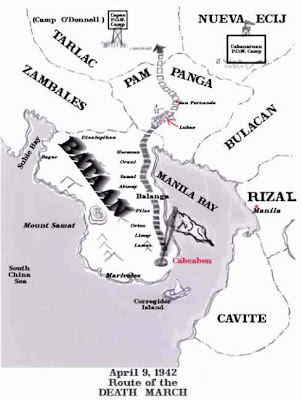 amps in the Philippines, China, Japan and Korea, where they were used as slave labor. Some worked in mines, others in farms and factories, while yet more unloaded ships in port areas, for the remainder of the war.
 amps in the Philippines, China, Japan and Korea, where they were used as slave labor. Some worked in mines, others in farms and factories, while yet more unloaded ships in port areas, for the remainder of the war.
 Most Americans did not find out about the atrocities that took place in Bataan until January 28, 1944, when the U.S. government released a joint report from the Army and Navy. This was compiled from the sworn statements of officers who survived the March and POW camps.
Bataan Day is a national holiday in the Philippines when large groups of its citizens solemnly re-walk parts of the death route and pay homage to the victims of the March. The battleground of Bataan is now a national shrine. In the U.S., the Bataan Memorial Death March takes place each year at White Sands Missile Range, New Mexico. More than 3,000 marchers from across the U.S. and from overseas tackle a 26.2-mile route through high desert terrain in honor of those who served.
Friday, April 06, 2007
CELEBRATING GOOD FRIDAY
Good Friday is the Friday before Easter or Pascha. It commemorates the crucifixion and death of Jesus at Calvary. This year, it is on April 6, 2007.
Good Friday is a holy day observed by most Christian religions. Special prayer services are often held on this day with readings from the Gospel giving accounts of the events leading up to the crucifixion. Mainstream Christian churches view Christ's crucifixion as a voluntary and vicarious act, and one by which, along with resurrection on the third day, death itself was conquered.
In the predominantly Catholic Philippines, the day is commemorated with street processions, the Way of the Cross, and a Passion play called the Sinakulo. The Church keep the day solemn by not tolling the church bells and no Mass will be celebrated. In some communities (most famously in San Fernando, Pampanga), the processions include devotees who self-flagellate and sometimes even have themselves nailed to crosses as expressions of penance. After three o'clock in the afternoon of Good Friday (the time at which Jesus is traditionally believed to have died), noise is discouraged, radio stations and television stations sign off, businesses automatically close, and the faithful are urged to keep a very solemn and prayerful disposition through Easter Sunday.
Good Friday is a holy day observed by most Christian religions. Special prayer services are often held on this day with readings from the Gospel giving accounts of the events leading up to the crucifixion. Mainstream Christian churches view Christ's crucifixion as a voluntary and vicarious act, and one by which, along with resurrection on the third day, death itself was conquered.
In the predominantly Catholic Philippines, the day is commemorated with street processions, the Way of the Cross, and a Passion play called the Sinakulo. The Church keep the day solemn by not tolling the church bells and no Mass will be celebrated. In some communities (most famously in San Fernando, Pampanga), the processions include devotees who self-flagellate and sometimes even have themselves nailed to crosses as expressions of penance. After three o'clock in the afternoon of Good Friday (the time at which Jesus is traditionally believed to have died), noise is discouraged, radio stations and television stations sign off, businesses automatically close, and the faithful are urged to keep a very solemn and prayerful disposition through Easter Sunday.
Wednesday, April 04, 2007
TV AND HEALTH UPDATE
I finally finished watching Lovers in Paris the other day. Although I thoroughly enjoyed the story, the end was a bit confusing to me. I'm just not sure if the subtitles were wrong or if it didn't get the actual translation of the dialogues in the story but when it ended, I was like, "Huh?" But still, the light comedic scenes in the movie were all right and the chemistry of the main characters was wonderful. I still have another Korean tv drama to watch but I think I'll do a Japanese drama first. I want to brush up on my Nihonggo. I really don't want to forget all the words and phrases I learned while I was in Japan...
.....
Ruther is getting better, I think. The last time we talked (which was just this afternoon), his voice sounded less hoarse. I hope his cold goes away very soon.
He also told me that someone took his Eddie Bauer umbrella yesterday while he and a few friends were at Yoshimura (the ramen place). He really liked that umbrella. So sad...
.....
Tomorrow is Maundy Thursday. Mommy says that we will be doing Visita Iglesia probably in the morning.
"Visita Iglesia" (Church Visit), which involves visiting seven or more churches to commemorate the Apostle's vigil while Jesus prayed in the Garden of Gethsemane, is the main Holy Thursday activity of many Roman Catholics. Filipinos do this usually to say their prayers or perform the Stations of the Cross. The Blessed Sacrament, or the symbol of the body of Christ, is exposed on a special altar of repose, which in Filipino is called the “monumento.” (http://www.sunstar.com.ph/static/pam/2006/04/13/oped/jun.malig.html)
.....
Ruther is getting better, I think. The last time we talked (which was just this afternoon), his voice sounded less hoarse. I hope his cold goes away very soon.
He also told me that someone took his Eddie Bauer umbrella yesterday while he and a few friends were at Yoshimura (the ramen place). He really liked that umbrella. So sad...
.....
Tomorrow is Maundy Thursday. Mommy says that we will be doing Visita Iglesia probably in the morning.
"Visita Iglesia" (Church Visit), which involves visiting seven or more churches to commemorate the Apostle's vigil while Jesus prayed in the Garden of Gethsemane, is the main Holy Thursday activity of many Roman Catholics. Filipinos do this usually to say their prayers or perform the Stations of the Cross. The Blessed Sacrament, or the symbol of the body of Christ, is exposed on a special altar of repose, which in Filipino is called the “monumento.” (http://www.sunstar.com.ph/static/pam/2006/04/13/oped/jun.malig.html)
Sunday, April 01, 2007
APRIL FOOLS' DAY
March is over and it's April once more. I hope the months fly by faster.
.....
We are getting into the "hot" phase of summer. Mid-April til May is usually the hottest time. I can't remember intolerable summers although it's usually the stifling humidity that gets to me. But then again, if we are just at home with a fan or air conditioning it's no problem. Sometimes though, it ruins some of our day plans because the sun is hot from 10am til 3pm and we have to well, work our way around that heat. Summer in the Philippines is hot hot hot! =D
.....
Curious about the history of April Fools? Well, here it is...
http://en.wikipedia.org/wiki/April_Fool
The origin of this custom has been much disputed. Many theories have been suggested.
What seems certain is that it is in some way or other a relic of those once universal festivities held at the vernal equinox, which, beginning on old New Year's Day, the 25th of March, ended on the 2nd of April.
It has been suggested that Europe derived its April-fooling from the French.[2] France was one of the first nations to make January 1 officially New Year's Day (which was already celebrated by many), by decree of Charles IX. This was in 1564, even before the adoption of the Gregorian calendar. Thus the New Year's gifts and visits of felicitation which had been the feature of the 1st of April became associated with the first day of January, and those who disliked or did not hear about the change were fair game for those wits who amused themselves by sending mock presents and paying calls of pretended ceremony on the 1st of April. French and Dutch references from 1508 and 1539 respectively describe April Fools' Day jokes and the custom of making them on the first of April.
.....
We are getting into the "hot" phase of summer. Mid-April til May is usually the hottest time. I can't remember intolerable summers although it's usually the stifling humidity that gets to me. But then again, if we are just at home with a fan or air conditioning it's no problem. Sometimes though, it ruins some of our day plans because the sun is hot from 10am til 3pm and we have to well, work our way around that heat. Summer in the Philippines is hot hot hot! =D
.....
Curious about the history of April Fools? Well, here it is...
http://en.wikipedia.org/wiki/April_Fool
The origin of this custom has been much disputed. Many theories have been suggested.
What seems certain is that it is in some way or other a relic of those once universal festivities held at the vernal equinox, which, beginning on old New Year's Day, the 25th of March, ended on the 2nd of April.
It has been suggested that Europe derived its April-fooling from the French.[2] France was one of the first nations to make January 1 officially New Year's Day (which was already celebrated by many), by decree of Charles IX. This was in 1564, even before the adoption of the Gregorian calendar. Thus the New Year's gifts and visits of felicitation which had been the feature of the 1st of April became associated with the first day of January, and those who disliked or did not hear about the change were fair game for those wits who amused themselves by sending mock presents and paying calls of pretended ceremony on the 1st of April. French and Dutch references from 1508 and 1539 respectively describe April Fools' Day jokes and the custom of making them on the first of April.
Friday, March 30, 2007
LENT IN THE PHILIPPINES (PART 2)
Linggo ng Palaspas
Palm Sunday of the Catholic Holy Week is ushered with a widely- practiced ritual; parishioners wave palm fronds, locally called palaspas, in the air, mimicking the crowd that met Christ upon his return to Jerusalem. Blessings, prayers and Sunday mass follows, in affirmation of the religious nature of this age-old custom.
The Pasyon
The Pasyon refers to the verse narrative on the life and sufferings of Jesus Christ. The pasyon text may be written in Tagalog or in other major Philippine languages, like Pampango, Ilocano, Pangasinan, Bicol, Ilongo, Cebuano, and Waray. There are also pasyon narrative among the Ibanag and Itawes of Cagayan, the Gaddang of Nueva Vizcaya, and the Cuyunon of Palawan.
Among the Tagalog, the most commonly used text is entitled Casaysayan ng pasiong mahal ni Jesucristong Panginoon natin na sucat ipag-alab ng puso ng sinumang babasa (An account of the sacred passion of our Lord Jesus Christ which should inflame the heart of anyone who reads it), which is one of the many later editions of a work by an unknown writer first published in 1814.
Continuous singing of this length is not practiced in the Spanish and Mexican lenten traditions. It relates to the Philippine cultural practice connected with epic singing during important celebrations of the community. The pasyon may also be chanted, though rarely now, during wakes and death anniversaries, as well as during the reenactment of Christ's Last Supper on Holy Thursday evening. There are various melodies and musical styles in the rendering of the pasyon.
Because the text is in 5-line stanzas while melodic phrases tend to be symmetrical, various techniques are employed to reconcile the difference. In a widely used, old Tagalog punto, the first musical phrase encompasses lines 1 and 2, while the second musical phrase covers lines 3, 4, and 5. In adapting folk song melodies or similar tunes, a four-phrase melody is first sung for lines 1 to 4, which is repeated to render lines 2 to 5. Another formula makes a four-phrase melody coincide with lines 1 to 4 and appends a stock melody or standard melodic ending for line five. Generally, pasyon singing is a capella.
Many innovations in pasyon singing have been introduced, like the use of the guitar or rondalla for accompaniment and the use of the accordion by a traveling group of pasyon singers. Singing of the pasyon is performed in two basic group formations. In the first, two people or groups of people sing alternately. In the second formation, each of the singers take their turns in singing a stanza of text.
The pasyon chanting tradition is seen by many of its practitioners as a vow or panata made by an individual or family, which in many cases has been passed on from one to two generations back.
Source: http://www.filipino.com.au/categ/culture/pasyon.htm
Palm Sunday of the Catholic Holy Week is ushered with a widely- practiced ritual; parishioners wave palm fronds, locally called palaspas, in the air, mimicking the crowd that met Christ upon his return to Jerusalem. Blessings, prayers and Sunday mass follows, in affirmation of the religious nature of this age-old custom.
The Pasyon
The Pasyon refers to the verse narrative on the life and sufferings of Jesus Christ. The pasyon text may be written in Tagalog or in other major Philippine languages, like Pampango, Ilocano, Pangasinan, Bicol, Ilongo, Cebuano, and Waray. There are also pasyon narrative among the Ibanag and Itawes of Cagayan, the Gaddang of Nueva Vizcaya, and the Cuyunon of Palawan.
Among the Tagalog, the most commonly used text is entitled Casaysayan ng pasiong mahal ni Jesucristong Panginoon natin na sucat ipag-alab ng puso ng sinumang babasa (An account of the sacred passion of our Lord Jesus Christ which should inflame the heart of anyone who reads it), which is one of the many later editions of a work by an unknown writer first published in 1814.
Continuous singing of this length is not practiced in the Spanish and Mexican lenten traditions. It relates to the Philippine cultural practice connected with epic singing during important celebrations of the community. The pasyon may also be chanted, though rarely now, during wakes and death anniversaries, as well as during the reenactment of Christ's Last Supper on Holy Thursday evening. There are various melodies and musical styles in the rendering of the pasyon.
Because the text is in 5-line stanzas while melodic phrases tend to be symmetrical, various techniques are employed to reconcile the difference. In a widely used, old Tagalog punto, the first musical phrase encompasses lines 1 and 2, while the second musical phrase covers lines 3, 4, and 5. In adapting folk song melodies or similar tunes, a four-phrase melody is first sung for lines 1 to 4, which is repeated to render lines 2 to 5. Another formula makes a four-phrase melody coincide with lines 1 to 4 and appends a stock melody or standard melodic ending for line five. Generally, pasyon singing is a capella.
Many innovations in pasyon singing have been introduced, like the use of the guitar or rondalla for accompaniment and the use of the accordion by a traveling group of pasyon singers. Singing of the pasyon is performed in two basic group formations. In the first, two people or groups of people sing alternately. In the second formation, each of the singers take their turns in singing a stanza of text.
The pasyon chanting tradition is seen by many of its practitioners as a vow or panata made by an individual or family, which in many cases has been passed on from one to two generations back.
Source: http://www.filipino.com.au/categ/culture/pasyon.htm
Thursday, March 29, 2007
LENT IN THE PHILIPPINES (PART 1)
Lent is a time when Catholics remember the cruxificion and resurrection of Jesus Christ. During the Lenten season, numerous Passion Plays are performed as part of the celebrations. People flock to Marinduque to watch the moriones in a spectacular reenactment of the legend of Longinus.
Holy Week
Holy Week is locally called Cuaresma or Semana Santa. The start of Holy Week is Palm Sunday. Catholics carry palm leaves, known as palaspas, to chuch for the priest to bless. Catholics also celebrate Maundy Thursday, attending church services and watching Passion Plays. In one practice called visita iglesia, Catholics try to visit as many churches as they can. On Good Friday, believers in certain areas, such as Manila, San Fernando in Pampanga Province, and Antipolo in Rizal Province, reenact the sufferings and death of Christ in the Cross. Although Good Friday is a somber time, Easter Sunday is a joyful occassion that starts with salubong, where the statues representing the Risen Christ and the Grieving Mother Mary are carried to meet at an appointed place.
Source: Festivals of the World: Philippines
Cuaresma
Lent prepares the Christian for the yearly commemoration of Christ's Death and Resurrection.
Forty weekdays- hence the term cuarsma in Spanish-are given over to prayer, almsgiving, fasting, and abstinence from meat. Christ's forty-day retreat in the desert and his success in resisting the devil's temptation to wealth, power, and glory inspires the Christian.
The month of April marks the celebration of Christ's death and resurrection, what the pious call in the Philippines "Holy Week" or Semana Santa. In contrast to other Christian countries, Filipino Catholics give emphasis on the suffering of Christ, rather than on His resurrection, on the belief that salvation comes at the end.
Religious piety is passionately displayed in different parts of the Philippines, particularly in the provinces where communities go on pilgrimage to as many churches and devotees re-enacting Christ's ordeal through real-life crucifixion under the scorching heat of the sun. Extreme forms of religious practices such as self-flagellation using whips tipped with sharp objects that scar the backs of hooded penitents are some of the rituals that are performed to this day. The penitents are taken down seconds after being nailed to the wooden crosses using 2-inch stainless steel nails soaked in alcohol. These crucifixions take place in the town of San Pedro, Pampanga, north capital of Manila.
Real-life crucifixion are not countenanced by the Catholic Church, but the fine line that separates religious ritual from spectacle is slowly erased as hundreds of tourists troop to this quaint town to witness the tradition in awe and amazement. Such rituals are part of a folk religious culture that has deep roots in a brand of obscurantism that dates back to the Spanish colonial period. Hispanic Filipinos likened the suffering of Christ to their oppression in the hands of their abusive Spanish landlords and friars. Indeed, "Holy Week" encapsulates the Filipino culture of suffering, poverty and illness; it speaks not just of our redemption in the next life, but also our travails of our present life.
But for modern day Filipinos, Holy Week is an opportunity to escape from the hustle and bustle of urban living to the serene beaches and picturesque landscapes spread across the archipelago. It is also a respite from the snarl of Manila's traffic jams and the din of political campaigning and electioneering that follows the Lenten season.
Source: http://www.filipinoheritage.com/religious/Cuaresma.htm
Holy Week
Holy Week is locally called Cuaresma or Semana Santa. The start of Holy Week is Palm Sunday. Catholics carry palm leaves, known as palaspas, to chuch for the priest to bless. Catholics also celebrate Maundy Thursday, attending church services and watching Passion Plays. In one practice called visita iglesia, Catholics try to visit as many churches as they can. On Good Friday, believers in certain areas, such as Manila, San Fernando in Pampanga Province, and Antipolo in Rizal Province, reenact the sufferings and death of Christ in the Cross. Although Good Friday is a somber time, Easter Sunday is a joyful occassion that starts with salubong, where the statues representing the Risen Christ and the Grieving Mother Mary are carried to meet at an appointed place.
Source: Festivals of the World: Philippines
Cuaresma
Lent prepares the Christian for the yearly commemoration of Christ's Death and Resurrection.
Forty weekdays- hence the term cuarsma in Spanish-are given over to prayer, almsgiving, fasting, and abstinence from meat. Christ's forty-day retreat in the desert and his success in resisting the devil's temptation to wealth, power, and glory inspires the Christian.
The month of April marks the celebration of Christ's death and resurrection, what the pious call in the Philippines "Holy Week" or Semana Santa. In contrast to other Christian countries, Filipino Catholics give emphasis on the suffering of Christ, rather than on His resurrection, on the belief that salvation comes at the end.
Religious piety is passionately displayed in different parts of the Philippines, particularly in the provinces where communities go on pilgrimage to as many churches and devotees re-enacting Christ's ordeal through real-life crucifixion under the scorching heat of the sun. Extreme forms of religious practices such as self-flagellation using whips tipped with sharp objects that scar the backs of hooded penitents are some of the rituals that are performed to this day. The penitents are taken down seconds after being nailed to the wooden crosses using 2-inch stainless steel nails soaked in alcohol. These crucifixions take place in the town of San Pedro, Pampanga, north capital of Manila.
Real-life crucifixion are not countenanced by the Catholic Church, but the fine line that separates religious ritual from spectacle is slowly erased as hundreds of tourists troop to this quaint town to witness the tradition in awe and amazement. Such rituals are part of a folk religious culture that has deep roots in a brand of obscurantism that dates back to the Spanish colonial period. Hispanic Filipinos likened the suffering of Christ to their oppression in the hands of their abusive Spanish landlords and friars. Indeed, "Holy Week" encapsulates the Filipino culture of suffering, poverty and illness; it speaks not just of our redemption in the next life, but also our travails of our present life.
But for modern day Filipinos, Holy Week is an opportunity to escape from the hustle and bustle of urban living to the serene beaches and picturesque landscapes spread across the archipelago. It is also a respite from the snarl of Manila's traffic jams and the din of political campaigning and electioneering that follows the Lenten season.
Source: http://www.filipinoheritage.com/religious/Cuaresma.htm
Wednesday, February 07, 2007
ZZZZZZZZZZZZZZZZ.....
source: Uncle John's Bathroom Reader
If it takes you less than 5 minutes to fall asleep, it probably means you're sleep-deprived. Healthy sleepers need between 10 and 15 minutes to doze off.
Researchers at Oxford University concluded that counting sheep may actually keep you awake. Why? Counting sheep is so boring that the mind brings other, more interesting thoughts to the surface just to keep itself occupied.
Your brain is more active when you're dreaming than it is when you're awake.
Having trouble falling asleep? Turn off all the lights or get some eyeshades. You need melatonin to feel drowsy, and melatonin production slows down when ambient light passes through the eyelids.
Certain scents can help you fall asleep. According to a recent study, the most effective aroma is jasmine.
Most primates sleep an average of 10 hours per night; humans average only 7. But that's a recent development. Until the turn of the 20th century, humans slept for 10 hours, too. Who's to blame? Thomas Edison. The invention of the lightbulb turned us into a society of night owls.
If you want to remember your dreams, write them down as soon as you wake up. After 5 minutes, 50% of the dream fades from memory; after 10 minutes, 90% is gone.
If it takes you less than 5 minutes to fall asleep, it probably means you're sleep-deprived. Healthy sleepers need between 10 and 15 minutes to doze off.
Researchers at Oxford University concluded that counting sheep may actually keep you awake. Why? Counting sheep is so boring that the mind brings other, more interesting thoughts to the surface just to keep itself occupied.
Your brain is more active when you're dreaming than it is when you're awake.
Having trouble falling asleep? Turn off all the lights or get some eyeshades. You need melatonin to feel drowsy, and melatonin production slows down when ambient light passes through the eyelids.
Certain scents can help you fall asleep. According to a recent study, the most effective aroma is jasmine.
Most primates sleep an average of 10 hours per night; humans average only 7. But that's a recent development. Until the turn of the 20th century, humans slept for 10 hours, too. Who's to blame? Thomas Edison. The invention of the lightbulb turned us into a society of night owls.
If you want to remember your dreams, write them down as soon as you wake up. After 5 minutes, 50% of the dream fades from memory; after 10 minutes, 90% is gone.
Tuesday, January 30, 2007
SOME FACTS ABOUT JAPAN
Mount Fuji is a sacred mountain for the Japanese. Pilgrimages are made to the mountain every year.
The Japanese word for Japan, Nihon (Nippon), means source of the sun.
The Ainu, the original inhabitants of Japan, are related to the people of Siberia.
Some of the oldest pottery in the world comes from Japan's Jomon Period (10,000 - 300 BC).
Seppuku, or hara-kiri, is ritual suicide by disembowelment and was considered an honorable way of dying, as defeated Roman generals were said to fall on their swords.
Japan has the highest density of robots in the world. There are approximately 800,00 industrial-use robots in operation around the world, and fully half of them in Japan. That's about 1 robot for every 310 people in Japan.
The most-visited amusement park in the world is Tokyo Disneyland. Opened in 1983, more than 17 million people visit it each year.
Japan has more active volcanoes than any other country in the world, with more than 10% of all the earth's volcanoes.
The longest transportation tunnel in the world is the Seikan tunnel connecting the main island of Honshu to Hokkaido.
The longest suspension bridge in the world is the Akashi Kaikyo Bridge connecting Kobe with Awaji Island.
The Japanese word for Japan, Nihon (Nippon), means source of the sun.
The Ainu, the original inhabitants of Japan, are related to the people of Siberia.
Some of the oldest pottery in the world comes from Japan's Jomon Period (10,000 - 300 BC).
Seppuku, or hara-kiri, is ritual suicide by disembowelment and was considered an honorable way of dying, as defeated Roman generals were said to fall on their swords.
Japan has the highest density of robots in the world. There are approximately 800,00 industrial-use robots in operation around the world, and fully half of them in Japan. That's about 1 robot for every 310 people in Japan.
The most-visited amusement park in the world is Tokyo Disneyland. Opened in 1983, more than 17 million people visit it each year.
Japan has more active volcanoes than any other country in the world, with more than 10% of all the earth's volcanoes.
The longest transportation tunnel in the world is the Seikan tunnel connecting the main island of Honshu to Hokkaido.
The longest suspension bridge in the world is the Akashi Kaikyo Bridge connecting Kobe with Awaji Island.
Sunday, January 28, 2007
SOME PHILIPPINE WORLD RECORDS
source: http://www.txtmania.com/trivia/world.php
The Leaf Musician
He became famous around the world for his distinct talent. The Guinness Book of World Records has recognized Filipino National Artist Levi Celerio as the only man who could play beautiful music with a leaf.Celerio appeared in "That's Incredible" and the Mel Griffin show where he played music with a leaf. The Guinness Book of World Records said: "The only leaf player in the world is in the Philippines". As a composer and lyricist, Celerio wrote more than 4,000 songs.
The Woman With 3,400 Shoes
Former First Lady Imelda Marcos was listed in the Guinness Book of World Records as the woman with the largest collection of shoes. Reports said that when the Marcos family fled to Hawaii during the People's Power Revolution in 1986, around 3,400 pairs of shoes were discovered in one room at Malacanang Palace. They were the First Lady's collection.In 1987, Mrs. Marcos denied this and claimed she had only 1,060 pairs of shoes. The former First Lady has an eight-and-a-half inch footwear size. She said her having many shoes is not a symbol of extravagance but an expression of love and appreciation for Filipino-made shoes. Most of her shoes, she added, were bought from Marikina, the shoe capital of the Philippines. For this, Marikina City had acquired 200 pairs of the Marcos shoes and put them on display at the city's shoe museum.
World's Sweetest Fruit
What can be considered as the world's sweetest mango is produced in the island province of Guimaras. While other countries have different varieties of the tropical mango (Mangifera indica), none of them tastes like the superbly delicious Guimaras mango, which is a variety of the popular Carabao Mango (Manginera indica).In 1995, the Guinness Book of World records listed the Carabao Mango as the sweetest fruit in the world. In the Philippines, mango ranks third among fruit crops in production, next to banana and pineapple. The country supplies mangoes to Japan, Hong Kong, Singapore and recently the United States. In 1995, the Philippines produced 432,322 metric tons of mangoes, with an average production of 6.35 metric tons per hectare and 250 kilograms per tree from a total production area of 68,056 hectares.
World's Largest Lantern
On December 24, 2002, the city of San Fernando in Pampanga province switched on the world's largest Christmas lantern - a P5-million structure with 26.8 meters in diameter.
World's Fastest Reader
As a student at the Northwestern University in Chicago, Illinois, Maria Teresa Calderon became the world's fastest reader. She set the record of having read 80,000 words per hour.
Sili King
The Guinness Book of World Records recognizes Eriberto Gonzales of Camalig, Albay as the fastest chili eater. In the Philippines, he is known as the "Sili King". Gonzales accomplished his feat in the "Sili-Eating Challenge 1999" in Bicol where he ate 350 pieces of sili in three minutes. (Source: Philippine Daily Inquirer)
World's Largest Synchronized Aerobics Exercises
On February 16, 2003, some 107,000 Filipinos joined a 30-minute aerobics exercise supervised by the Department of Health (DOH) at Rizal Park in Manila, which could be the largest synchronized exercise in the world. Thousands of people also gathered at different venues in Cebu City and Davao City to participate in the exercise simultaneous with the Manila event. The new record broke the previous Guinness Book of World Records set at a park in Guadalajara, Mexico by some 38,633 people who joined the massive aerobics exercises in June 1998.
World's Largest Shoes
In December 2002, the Guinness Book of World Records has recognized Marikina City for crafting the world's largest pair of shoes - each measuring 5.5 meters (18.2 feet) long, 2.25 meters (7.4 feet) wide and 1.83 meters (six feet) high. The materials for the P1.2 million pair of shoes could produce 250 pairs of regular shoes.
World's Largest Pearl
A Filipino diver discovered what is now described as the world's largest pearl in a giant Tridacna (mollusk) under the Palawan Sea in 1934. Known as the "Pearl of Lao-Tzu", the gem weighs 14 pounds and measures 9 ½ inches long and 5 ½ inches in diameter. As of May 1984, it was valued at US$42 million. It is believed to be 600 years old.
The Leaf Musician
He became famous around the world for his distinct talent. The Guinness Book of World Records has recognized Filipino National Artist Levi Celerio as the only man who could play beautiful music with a leaf.Celerio appeared in "That's Incredible" and the Mel Griffin show where he played music with a leaf. The Guinness Book of World Records said: "The only leaf player in the world is in the Philippines". As a composer and lyricist, Celerio wrote more than 4,000 songs.
The Woman With 3,400 Shoes
Former First Lady Imelda Marcos was listed in the Guinness Book of World Records as the woman with the largest collection of shoes. Reports said that when the Marcos family fled to Hawaii during the People's Power Revolution in 1986, around 3,400 pairs of shoes were discovered in one room at Malacanang Palace. They were the First Lady's collection.In 1987, Mrs. Marcos denied this and claimed she had only 1,060 pairs of shoes. The former First Lady has an eight-and-a-half inch footwear size. She said her having many shoes is not a symbol of extravagance but an expression of love and appreciation for Filipino-made shoes. Most of her shoes, she added, were bought from Marikina, the shoe capital of the Philippines. For this, Marikina City had acquired 200 pairs of the Marcos shoes and put them on display at the city's shoe museum.
World's Sweetest Fruit
What can be considered as the world's sweetest mango is produced in the island province of Guimaras. While other countries have different varieties of the tropical mango (Mangifera indica), none of them tastes like the superbly delicious Guimaras mango, which is a variety of the popular Carabao Mango (Manginera indica).In 1995, the Guinness Book of World records listed the Carabao Mango as the sweetest fruit in the world. In the Philippines, mango ranks third among fruit crops in production, next to banana and pineapple. The country supplies mangoes to Japan, Hong Kong, Singapore and recently the United States. In 1995, the Philippines produced 432,322 metric tons of mangoes, with an average production of 6.35 metric tons per hectare and 250 kilograms per tree from a total production area of 68,056 hectares.
World's Largest Lantern
On December 24, 2002, the city of San Fernando in Pampanga province switched on the world's largest Christmas lantern - a P5-million structure with 26.8 meters in diameter.
World's Fastest Reader
As a student at the Northwestern University in Chicago, Illinois, Maria Teresa Calderon became the world's fastest reader. She set the record of having read 80,000 words per hour.
Sili King
The Guinness Book of World Records recognizes Eriberto Gonzales of Camalig, Albay as the fastest chili eater. In the Philippines, he is known as the "Sili King". Gonzales accomplished his feat in the "Sili-Eating Challenge 1999" in Bicol where he ate 350 pieces of sili in three minutes. (Source: Philippine Daily Inquirer)
World's Largest Synchronized Aerobics Exercises
On February 16, 2003, some 107,000 Filipinos joined a 30-minute aerobics exercise supervised by the Department of Health (DOH) at Rizal Park in Manila, which could be the largest synchronized exercise in the world. Thousands of people also gathered at different venues in Cebu City and Davao City to participate in the exercise simultaneous with the Manila event. The new record broke the previous Guinness Book of World Records set at a park in Guadalajara, Mexico by some 38,633 people who joined the massive aerobics exercises in June 1998.
World's Largest Shoes
In December 2002, the Guinness Book of World Records has recognized Marikina City for crafting the world's largest pair of shoes - each measuring 5.5 meters (18.2 feet) long, 2.25 meters (7.4 feet) wide and 1.83 meters (six feet) high. The materials for the P1.2 million pair of shoes could produce 250 pairs of regular shoes.
World's Largest Pearl
A Filipino diver discovered what is now described as the world's largest pearl in a giant Tridacna (mollusk) under the Palawan Sea in 1934. Known as the "Pearl of Lao-Tzu", the gem weighs 14 pounds and measures 9 ½ inches long and 5 ½ inches in diameter. As of May 1984, it was valued at US$42 million. It is believed to be 600 years old.
Thursday, January 25, 2007
JANUARY 25
Events that happened on January 25:
1858 - The Wedding March by Felix Mendelssohn becomes a popular wedding recessional after it is played on this day at the marriage of Queen Victoria's daughter, Victoria, and Friedrich of Prussia.
1881 - Thomas Edison and Alexander Graham Bell form the Oriental Telephone Company.
1890 - Nellie Bly completes her round-the-world journey in 72 days.
1915 - Alexander Graham Bell inaugurates U.S. transcontinental telephone service.
1918 - Russia declared a republic of Soviets.
1924 - The 1924 Winter Olympics open in Chamonix, France (in the French Alps), inaugurating the Winter Olympic Games.
1929 - birth of Benny Golson, Jazz Musician
1933 - birth of Corazon Aquino, President of the Philippines
1945 - Battle of the Bulge ends.
1947 - death of Al Capone, American gangster
1971 - Charles Manson and three female "family members" are found guilty of murder and sentenced to life imprisonment.
1980 - birth of Alicia Keys, American singer
1990 - death of Ava Gardner, American actress
1995 - The Norwegian Rocket Incident: Russia almost launches a nuclear attack after Black Brant XII, a Norwegian research rocket, is mistaken for a US Trident missile by the Olenegorsk early-warning radar station.
2004 - Opportunity (MER-B) lands on surface of Mars.
1858 - The Wedding March by Felix Mendelssohn becomes a popular wedding recessional after it is played on this day at the marriage of Queen Victoria's daughter, Victoria, and Friedrich of Prussia.
1881 - Thomas Edison and Alexander Graham Bell form the Oriental Telephone Company.
1890 - Nellie Bly completes her round-the-world journey in 72 days.
1915 - Alexander Graham Bell inaugurates U.S. transcontinental telephone service.
1918 - Russia declared a republic of Soviets.
1924 - The 1924 Winter Olympics open in Chamonix, France (in the French Alps), inaugurating the Winter Olympic Games.
1929 - birth of Benny Golson, Jazz Musician
1933 - birth of Corazon Aquino, President of the Philippines
1945 - Battle of the Bulge ends.
1947 - death of Al Capone, American gangster
1971 - Charles Manson and three female "family members" are found guilty of murder and sentenced to life imprisonment.
1980 - birth of Alicia Keys, American singer
1990 - death of Ava Gardner, American actress
1995 - The Norwegian Rocket Incident: Russia almost launches a nuclear attack after Black Brant XII, a Norwegian research rocket, is mistaken for a US Trident missile by the Olenegorsk early-warning radar station.
2004 - Opportunity (MER-B) lands on surface of Mars.
Friday, January 12, 2007
10 TIPS TO REDUCE GLOBAL WARMING
1) Plant a tree, preferably an RPM tree as they absorb more carbon dioxide
2) Reduce, reuse and recycle
3) Use less heat and air conditioning
4) Replace regular light bulbs with compact florescent light bulbs
5) Drive less and drive smart
6) Buy energy-efficient products
7) Use less hot water
8) Use the “off” switch
9) Get a report card from your utility company
10) Encourage others to conserve
2) Reduce, reuse and recycle
3) Use less heat and air conditioning
4) Replace regular light bulbs with compact florescent light bulbs
5) Drive less and drive smart
6) Buy energy-efficient products
7) Use less hot water
8) Use the “off” switch
9) Get a report card from your utility company
10) Encourage others to conserve
Thursday, January 11, 2007
OUR CHANGING EARTH
About 2 weeks ago, I read a news article (read here) about a giant ice shelf (the size of 11,000 football fields) that broke off from Canada's Arctic. Scientists blame dramatic climatic changes as the culprit. This is really disturbing. Shouldn't these changes occur slowly over a period of hundreds of years? Apparently not. Experts are even saying such changes in our earth have become accelerated due to the greenhouse effect, pollution, etc. Is there any way to remedy this? =(
.....
Did you know that the level of the world's oceans is 500 feet higher than it was 25,000 years ago?
.....
Today, I read another environmentally-related article (read here) about 2006 being the warmest year ever. 'Nuff said.
....
Need more proof that we are on an environmental decline? Here they are:
- Considerable extinction risk for whale group
- Warming seas send big-headed fish deeper
- 2007 will be warmest on record, experts predict
- Polar Bears May Be Listed as Threatened in the USA
- Climate Change Increases Food Security Concerns
- Ebola Virus Plus Hunting Could Wipe Out Gorillas
- No Climate Benefit Gained by Planting Temperate Forests
- China's Yangtze River Dolphin Declared Extinct
- Porpoises Starving in Europe Due to Ocean Warming
- Coal Mining Causing Earthquakes, Study Says
- Florida's Wild Rivers Increasingly Polluted, Experts Say
- Arctic Summers Ice Free by 2040, Study Predicts
.....
Did you know that the level of the world's oceans is 500 feet higher than it was 25,000 years ago?
.....
Today, I read another environmentally-related article (read here) about 2006 being the warmest year ever. 'Nuff said.
....
Need more proof that we are on an environmental decline? Here they are:
- Considerable extinction risk for whale group
- Warming seas send big-headed fish deeper
- 2007 will be warmest on record, experts predict
- Polar Bears May Be Listed as Threatened in the USA
- Climate Change Increases Food Security Concerns
- Ebola Virus Plus Hunting Could Wipe Out Gorillas
- No Climate Benefit Gained by Planting Temperate Forests
- China's Yangtze River Dolphin Declared Extinct
- Porpoises Starving in Europe Due to Ocean Warming
- Coal Mining Causing Earthquakes, Study Says
- Florida's Wild Rivers Increasingly Polluted, Experts Say
- Arctic Summers Ice Free by 2040, Study Predicts
Wednesday, January 10, 2007
JANUARY FIESTAS IN THE PHILIPPINES
I hope one day to witness firsthand the Ati-Atihan and Sinulog festivals...
The fiesta is part and parcel of Filipino culture. Through good times and bad times, the fiesta must go on. Each city and barrio has at least one local festival of its own, usually on the feast of its patron saint, so that there is always a fiesta going on somewhere in the country. But the biggest and most elaborate festival of all is Christmas, a season celebrated with all the pomp and pageantry the fun-loving Filipino can manage.
ATI-ATIHAN
Kalibo, Aklan
13-19 January
The Ati-Atihan Festival commemorates the 13th century land deal between 10 migrating Bornean chieftains and the aboriginal Ati King Marikudo. It also honors the town patron, the infant Sto. Niño.
The ceaseless, rhythmic pounding of drums get to you, and before you know it you are on the street, shuffling your feet, shaking your head, waving your hands - and joining thousands of soot-blacked, gaily-costumed revelers in an ancient ritual of mindless merriment. A familiar battle cry reaches your ears, and amidst all this confusion you remember where you are: Kalibo, Aklan. "Viva, Sto. Niño!"
The Ati-Atihan celebration is echoed in many parts of the country.
SINULOG
Cebu City
18-19 January

Cebu City's fiesta of fiestas. Characterized by its peculiar two-steps-forward-and-one-step-backward shuffle, thus simulating the Holy Child of the shores, the Sinulog is a century-old tradition observed in the part of Visayas region. The prayer-dance is synchronized to the beat of drums and shouts of "Pit Señor! Viva Sto. Niño!" Feel free to dance with the best of them, grooving all the way to the grand final presentation at the Cebu City Sports Center.
DINAGYANG
Iloilo City
25-26 January

Merry mayhem breaks loose in Iloilo City during this weekend, when Ilonggos leave everything behind to join in the fiesta of the year. All inhibitions are dropped: boring everyday clothes are exchanged for "Ati" warrior costumes and black body paint. Shields and "weapons" are held amidst the pounding rhythm of drums, the costumed Ilonggos put their best feet forward in celebration of…..Dinagyang!
source: http://www.tourism.gov.ph/discover/festivals.asp
The fiesta is part and parcel of Filipino culture. Through good times and bad times, the fiesta must go on. Each city and barrio has at least one local festival of its own, usually on the feast of its patron saint, so that there is always a fiesta going on somewhere in the country. But the biggest and most elaborate festival of all is Christmas, a season celebrated with all the pomp and pageantry the fun-loving Filipino can manage.
ATI-ATIHAN
Kalibo, Aklan
13-19 January
The Ati-Atihan Festival commemorates the 13th century land deal between 10 migrating Bornean chieftains and the aboriginal Ati King Marikudo. It also honors the town
 patron, the infant Sto. Niño.
The ceaseless, rhythmic pounding of drums get to you, and before you know it you are on the street, shuffling your feet, shaking your head, waving your hands - and joining thousands of soot-blacked, gaily-costumed revelers in an ancient ritual of mindless merriment. A familiar battle cry reaches your ears, and amidst all this confusion you remember where you are: Kalibo, Aklan. "Viva, Sto. Niño!"
The Ati-Atihan celebration is echoed in many parts of the country.
SINULOG
Cebu City
18-19 January

Cebu City's fiesta of fiestas. Characterized by its peculiar two-steps-forward-and-one-step-backward shuffle, thus simulating the Holy Child of the shores, the Sinulog is a century-old tradition observed in the part of Visayas region. The prayer-dance is synchronized to the beat of drums and shouts of "Pit Señor! Viva Sto. Niño!" Feel free to dance with the best of them, grooving all the way to the grand final presentation at the Cebu City Sports Center.
DINAGYANG
Iloilo City
25-26 January

Merry mayhem breaks loose in Iloilo City during this weekend, when Ilonggos leave everything behind to join in the fiesta of the year. All inhibitions are dropped: boring everyday clothes are exchanged for "Ati" warrior costumes and black body paint. Shields and "weapons" are held amidst the pounding rhythm of drums, the costumed Ilonggos put their best feet forward in celebration of…..Dinagyang!
source: http://www.tourism.gov.ph/discover/festivals.asp
Subscribe to:
Posts (Atom)


